Precision Springs
Maximum Precision from Solid Material
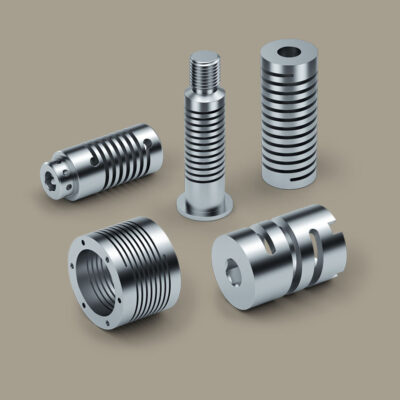
Precision springs are machined from solid stock and offer a precisely tailored combination of spring characteristics. Unlike coiled springs, they do not generate any artificial material stresses—ensuring the highest precision, linear response curves, and maximum service life, even in dynamic and demanding applications.
Precision Springs – High-Precision Spring Solutions for Demanding Applications
Precision springs are machined springs made from solid stock, characterized by their exceptional accuracy, high repeatability, and long service life. Unlike conventional coiled springs, they are manufactured from a single piece of material, thereby offering significantly greater operational reliability as well as a precise, linear spring characteristic curve. They are ideal for applications where exact force curves and reliable repeatability are critical.
What are precision springs?
Precision springs are mechanical springs manufactured by machining solid material. In this process, a helical structure is created in a workpiece, giving the spring its elastic properties.
Unlike conventional springs, this manufacturing process does not create any additional internal stresses, resulting in a particularly uniform and reproducible spring action.
You can also find additional solutions for precise motion and force transmission in our categories for Helix couplings and Disc pack couplings.
How do precision springs work?
The function of precision springs is based on the elastic deformation of their integrated helical structure. They can absorb compressive, tensile, torsional, and bending loads and allow for a specific combination of different spring characteristics within a single component.
Due to the high manufacturing precision, all coils are active, causing the spring to deform uniformly under load and then return to its original shape. The result is a nearly perfectly linear spring characteristic curve with very high repeatability.
What are the advantages of precision springs?
Precision springs offer numerous technical and economic advantages. Since they are manufactured from a single component, there is no need for additional parts, which simplifies assembly and reduces system complexity.
In addition, they enable very high precision with constant spring rates and minimal tolerances. Their high fatigue strength ensures a long service life, even under dynamic loads.
Furthermore, additional functions and fasteners can be integrated directly into the spring, thereby reducing installation space, weight, and costs.
Where are precision springs used?
Precision springs are used wherever precise force curves and reliable repeatability are required. Typical applications include high-precision control systems, mechanical engineering, medical technology, and automation technology.
They demonstrate their advantages over conventional springs particularly in applications involving small stroke movements or sensitive mechanical systems.
What designs and configurations are available?
Precision springs are available in various designs and can be customized to suit the specific application. They can be configured as compression, tension, or torsion springs and also allow for the combination of multiple load types within a single component.
In addition, single-, double-, or multi-coil helical structures can be implemented. Multi-coil designs, for example, prevent lateral buckling or unwanted twisting of the spring ends.
What types of mounting are possible?
Unlike conventional springs, where mountings are often achieved using bent wire ends, connections can be integrated directly into the component in precision springs.
Typical mounting solutions include threaded studs, pin holes, grooves, or flanges. These design options increase load-bearing capacity and improve force transmission to adjacent components. At the same time, the service life of the spring is extended.
What materials are used?
Precision springs offer a wide variety of materials, as the material is machined rather than formed. In addition to traditional steels, aluminum, plastics, or titanium can also be used.
This flexibility allows for use in a wide range of environments, such as corrosive conditions or applications with specific requirements regarding weight or electrical insulation.
When are precision springs the right choice?
Precision springs are the ideal solution when the highest demands are placed on accuracy, repeatability, and service life. They are particularly suitable for applications where conventional springs reach their limits due to tolerances, wear, or uneven force distribution.
Thanks to their linear spring characteristic curve and the ability to integrate additional functions, they contribute significantly to the optimization of machines and systems.
Are custom precision springs possible?
Yes, precision springs can be designed entirely to customer specifications. Geometry, material, spring characteristics, and fasteners can be precisely tailored to the specific application.
By integrating multiple functions into a single component, the number of parts, assembly effort, and procurement costs can be significantly reduced. At the same time, system reliability increases, as only a single central component is required.
Do you need more information or detailed advice on your application? Then please do not hesitate to contact us. We are looking forward to your request!